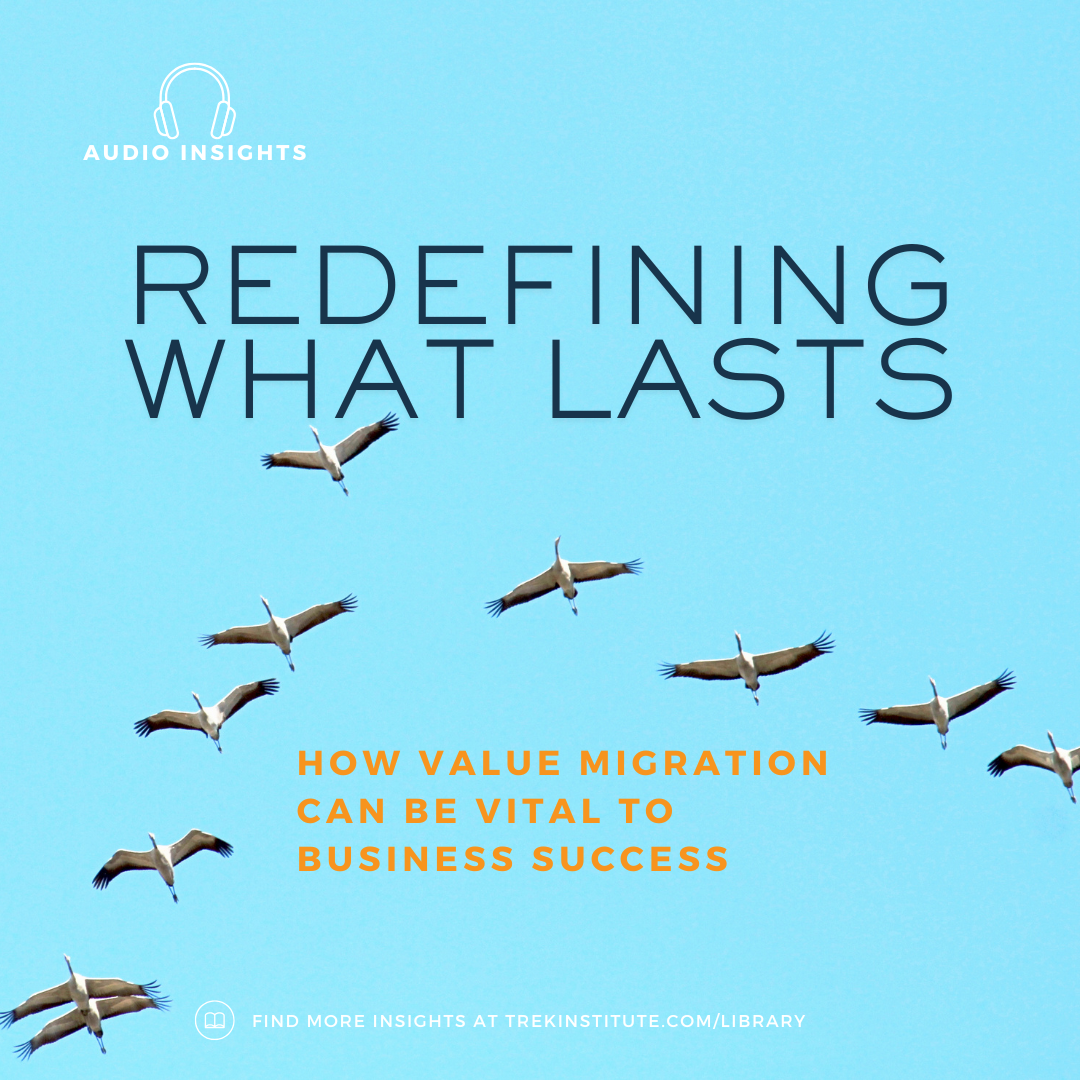
Redefining What Lasts
How Value Migration Can Be Vital to Business Success
Insights from Alexsa Young, CMO, Base Camp @ Trek
Today, value is both familiar and elusive. Many advisors can describe what they deliver, such as financial plans or investment management. However, fewer stop to examine how the perception of that value changes over time. The businesses that endure are rarely those that cling to what once worked. Instead, they are the ones that continually redefine what their customer finds valuable and realign around the expectations of a shifting market before they are forced to.
The idea of value migration is not limited to financial services. Across industries, companies rise and fall based on how quickly they recognize that the market’s definition of value has shifted. By studying those who have navigated that change well, advisors and their teams can better anticipate their own evolution.
Two major companies help illustrate this point clearly. One transformed its foundation entirely by moving from the tangible to the intangible. The other kept its identity while quietly expanding what its promise meant to its customer. Together, they offer a compelling look at how value changes, and how recognizing that change early can help shape the future of any business.
Studying these examples is not about comparing a financial services business to a global giant, but reflecting on the overarching concept of value proposition, and asking “If I we’re to still matter in 10 to 20 years from now, how must our value change?”
A Service-Centered Transformation
The story of IBM illustrates how a company’s survival often depends on its ability to redefine what “value” actually means to the people it serves. Once known primarily for its physical products, such as punch-cards, mainframes, and the heavy machinery of enterprise computing, IBM recognized over time that the world no longer valued ownership of hardware in the same way. What customers needed was not more machines, but more help making sense of them.
With this shift in the technology landscape, IBM gradually repositioned itself around software, cloud solutions, and consulting, moving away from being a manufacturer to a technology partner. This shift didn’t happen overnight, but unfolded through decades of changed, marked by hard lessons about what customer were truly willing to pay for: integration, adaptability, and insight.
The transformation was as much cultural as it was operational. IBM had to shed its total reliance on tangible products and learn to sell something far less visable but far more valuable: expertise. Its teams had to embrace a service mindset build on solving complex challenges rather than simply delivering physical tools to address them. In the process, IBM went from defining its worth by the technology it built to defining it by the success it enabled for others.
For advisors, that same shift is already underway. The most valuable advisory businesses today are not those that merely deliver investment performance or planning, but those that help clients connect the dots between their financial decisions and their lives. The deliverables remain important, but the deeper value now lies in interpretation, anticipation, and guidance. It is the human translation of complexity into clarity that creates long-term success.
Questions to Ask Yourself:
- How much of our value today comes from what we produce rather than from what we enable?
- If technology can replicate part of what we offer, where does our irreplaceable value begin?
- Do our internal processes reflect a transactional mindset, or are we structure to deliver ongoing partnership and insight?
- Are we building a culture that defines success through the success of our clients?
Offering Expansion
Unlike IBM’s need to survive, some transformations are less dramatic. Others happen quietly, almost invisibly, until one day they define the standard everyone else follows. Walmart’s identity has long been tied to its promise of “Every Day Low Price,” a model build on efficiency and scale. Yet, over time, Walmart found the need to expand what that promise means without abandoning the principle behind it.
As Forbes observed, Walmart’s success now rests on pairing low prices with convenience. Rather than reinventing itself, the company deepened its value proposition. It invested heavily in e-commerce, delivery infrastructure, store modernization, and membership programs such as Walmart+, which provides customers with free shipping and faster service. Its 2025 business strategy emphasizes “price, assortment, experience, and trust,” words that signal a broader understanding of what customers consider valuable.
The shift was gradual but deliberate. Walmart recognized that modern consumers define value in more complex terms than price alone. Saving money remains essential, but saving time and creating convenience have also become equally powerful motivators. By reducing friction and blending physical and digital experiences, Walmart made the act of shopping itself part of the value it delivers.
For independent advisory businesses, this example offers a different kind of lesson. Not every improvement needs to be a reinvention. Sometimes value expands through subtle adjustments that make your existing promise more relevant to modern expectations. Whether that means integrating digital tools for clients, increasing transparency, or refining communication frequency, incremental changes can add depth to value without changing the core value of the business.
Questions to Ask Yourself:
- How clearly have we defined the core promise of our business?
- In what ways could we enhance that promise without changing its foundation?
- Are we actively adapting to how our clients define convenience, connection, and confidence today?
- Do we regularly evaluate our offering through the lens of client experience rather than operational ease?
Anticipating Where Value is Headed
While IBM and Walmart took different paths, the lesson they share is universal. Both realized that value migration is inevitable, and that waiting to react could be fatal. IBM rebuilt its identity by moving up the value chain from mainly focusing on hardware, to integrating hardware with the services that outweighed their value. Walmart preserved its core identity by broadening what “low price” means in a connected world. Each success depended on understanding not just what customers wanted, but what they were beginning to expect.
Anticipating value migration begins with awareness. Financial planning and investment management will always matter, but the context surrounding them changes. Technology has simplified access to information. Younger generations of clients expect real-time engagement and transparency. Families seek coordination across multiple aspects of their financial lives. The traditional value of financial advisors – trust, expertise, and performance – still applies, but how its delivered must migrate to match modern expectations.
Advisors who view their value as fixed risk falling behind as quickly as companies that ignore market signals. Those who continuously revisit what clients need and how they define a meaningful relationship are better positioned to remain relevant, profitable, and trusted.
Reflection:
- Value is dynamic, not static. It requires constant re-evaluation and communication.
- Service depth matters more than product breadth. What you do is less important than how it helps clients move forward.
- Convenience, access, and personalization are rising expectations.
- Culture drives adaptability. Businesses must understand not only what is changing, but why change may be necessary.
- Communication keeps your value visible. Clients must see and feel the migration of your service.