
BUILDING CHALLENGE STATEMENTS
Insights from Base Camp
Everything is great. Until it’s not.
As they say, “if it’s not broken, don’t fix it.” But what if operating your business the way you think it should be going, maintaining existing processes and practices, has the potential to put your resources at risk going forward?
Not addressing the challenges of existing operations is particularly important for your growth. Without the most efficient processes, systems and people in place, how can you scale as you grow?
After identifying the risks to your business in the previous Trek, you may have found that there could be some significant impacts to various areas of your business. Everything from client onboarding to cultural shifts can be impacted by stagnant operations.
It’s important to address those risks and impacts to identify operational challenges by creating challenge statements. This practice gives you the opportunity to dive into existing challenges you may have in order to discover what the true root cause may be. Additionally, they are particularly helpful because they prevent us from making assumptions about our problems or getting stuck on tangents while we work through them.
Why use a challenge statement?
Challenge statements define your goals for projects so that team members can work together more efficiently towards those objectives. They help identify issues before they spiral out of control into something more significant than anticipated. They also allow you to focus on creating manageable tasks rather than solving everything at once, which leads to poor decision-making and wasted time resources (both money and human resources).
How to Define a Challenge Statement
A good challenge statement is human-centered, focusing on the client’s or team’s needs. It does not address how a project is completed but should instead focus on why it was created in the first place and what goal(s) need to be achieved for success.
Define:
- Who? Who is experiencing the challenge? Who will be the focus of your statement?
- What is the problem? What is the ultimate impact? What background information do you need?
- Where? Where is the challenge occurring? In which context, situation, or space is your team or the client confronted with this challenge?
- When? When does it need to be fixed?
- Why? Why does it matter? What value would it bring to the user and the business by solving this challenge? Why is it essential to solve this problem right now?
Understanding the Challenge
Here’s another job description best practice: Think carefully about requiring a four-year college degree.
A challenge statement is a way of defining the problems facing your project or business in clear and concise language. This helps you identify what has gone wrong, find solutions to the problem, and make progress.
How should things work? Build context on how you believe things should be working before you begin digging into the potential reasons.
Why does it matter? Why is it so important to solve this challenge? Could it lower costs? Increase productivity? Eliminate wasted time? Does it have an impact on your client experience?
How can I substantiate this challenge? Do you have “evidence” to back up this challenge and why it has the potential to impact your business or the functions of your team?
There are many potential solutions, but what is the root of the problem? Coming up with multiple solutions may be easy but identifying the root cause of the problem in the first place can prove to be a difficult task. It may take a few rounds of brainstorming but discovering the root cause can provide for more clarity and impactful solutions.
WHAT DOES A CHALLENGE STATEMENT LOOK LIKE?
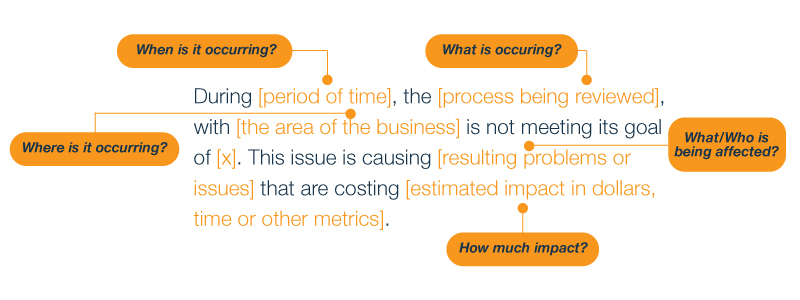
Examples of Good/Bad Statements
Bad Challenge Statement: “I have a hard time finding my keys.”
This statement does not give any background information about the context, what is causing this issue, and how often will this occur? Who are they for? What’s their motivation to solve them? How would solving this challenge help going forward?
Good Challenge Statement: “It is difficult to find the car keys when rushing out of the house. Because of this, I am late for appointments or have missed them entirely.”
This challenge statement shows what’s causing this issue, why is it essential that it gets solved right now, and who is experiencing the challenge. It also provides a lead into better developing a solution based on the root cause of the challenge.
"If I had one hour to save the world, I would spend 55 minute defining the problem and only 5 minutes finding the solution."
-Albert Einstein
Example of How to Analyze a Challenge Statement
Analysis: Analysis is used to identify and validate the underlying reason(s) for the challenge.
It should:
1.) Seek to understand the cause of the challenge before identifying solutions.
2.) Be driven by facts
3.) Be an efficient processes
Example Challenge Statement:
“The time between a client meeting and account opening is too long.”
Why? Schwab processing time is too long?
Action:? None possible
Root Cause? No
Why? Base Camp processing time is too long?
Action? Manage our own openings?
Root cause? No
Why? The communication within our team about opening is held too long.
Action? Insert a 5-minute time slot following each client meeting for knowledge and action item transfer. As a result, we can begin to work in quicker collaboration on account openings.
Root Cause? Yes

No posts found!